FALL 2026 UPDATE
goHeather is now a full legal AI. Create documents, review documents, research the law.
Try For Free Now



Buy-side SaaS contracts move through most businesses constantly. A new vendor sends over an MSA. Finance flags a renewal that needs sign-off. Procurement receives a DPA, an order form, and an AI addendum stapled to the bottom of the stack. Most of these end up in front of someone in procurement, finance, sales ops, or IT, not in front of a lawyer, and they get a quicker read than the dollar value of the deal might suggest.
This post is about how teams in that position can use a contract review AI to handle SaaS agreements with more confidence, and how goHeather in particular is built for that job.
A SaaS agreement is not a software license. You are not buying software. You are paying for ongoing access to software the vendor hosts, controls, updates, and can change. That distinction shapes the rest of the contract.
The result is that the risks sit in places a non-lawyer reviewer would not naturally look. Data rights. What the vendor's models are allowed to do with what you upload. Ownership of inputs and outputs. Sub-processor disclosure. Liability caps. Auto-renewal mechanics. What happens to your data on termination. AI-specific indemnification. Security obligations. Price escalators on renewal.
None of that is visible from a price quote, and most of it is spread across an MSA, a DPA, an order form, and a set of web-linked policies that the contract incorporates by reference. The practical question for a non-lawyer reviewer is not whether to read the contract. It is how to read it efficiently enough to know what to ask, what to flag, and when the deal is significant enough to bring in a lawyer.
goHeather is a contract review AI trained by lawyers. It provides legal information, not legal advice, and it is not a substitute for a lawyer on any deal that warrants one. What it does is surface the issues in a SaaS contract clearly enough that the team handling the review can act on them, and a lawyer brought in afterward can spend their time on the parts that matter.
Side awareness. When you tell goHeather you are the customer rather than the vendor, the analysis adjusts. A liability cap that reads as protective from the vendor's side reads as a risk from yours. The same language, flagged differently depending on which side of the deal you are on. General-purpose AI tools do not do this, and reviewing a vendor's draft without a defined perspective is one of the most common sources of weak output.
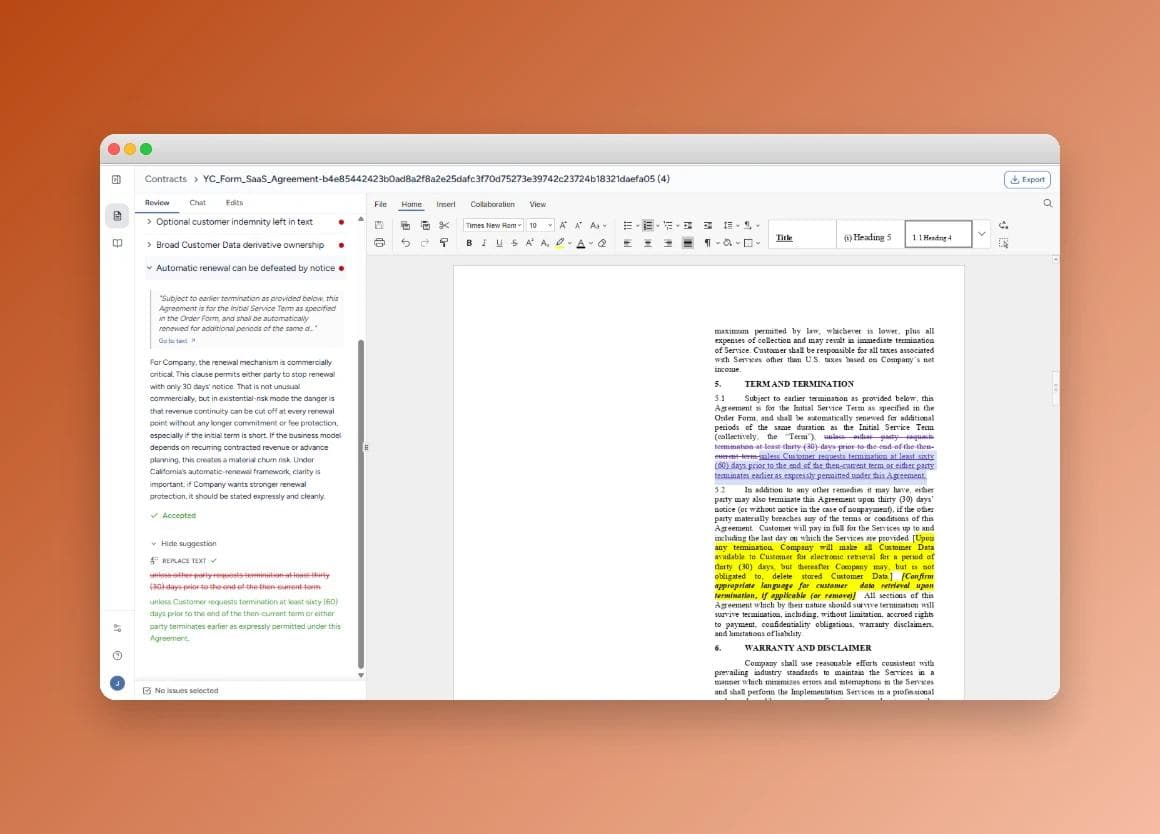
Issue spotting in plain English. The review surfaces dozens of issues, sometimes hundreds, ranked by severity with a red, yellow, and green system. Each finding quotes the relevant language from the contract, explains in plain English what the issue is, and suggests sample language the team can use as a starting point for redlines. The goal is to make sure nothing important goes unread, not to tell anyone what to sign.
Playbooks. If your company has a standard position on SaaS terms, the kind of thing that often lives in a senior person's head or in a Slack thread, you can encode it as a Playbook and apply it to every contract going forward. Common items: liability caps of at least 12 months of fees with carve-outs for confidentiality and data breach; no use of Customer Data to train AI models without consent; minimum 30 days' notice for auto-renewal; usable-format data export on termination. Once a Playbook is in place, contracts get reviewed against the same standards regardless of who is running the review that week. Playbooks can be built manually, or generated by uploading a contract you already consider acceptable and letting goHeather extract the rules.
Multi-document review. A SaaS deal usually arrives as a stack: MSA, DPA, security exhibit, order form, sometimes an AI addendum. goHeather reviews the full stack in one session and produces an integrated set of findings. This catches inconsistencies across documents that single-file reviews miss, such as a security exhibit promising one breach-notification window and a DPA promising another.
AI chat over the contract. When a clause references defined terms in another exhibit, or when a paragraph is just hard to follow, the built-in chat lets you ask questions with the document loaded as context. Useful for clause-level explanation, for asking what a defined term means in practice, or for getting goHeather to draft alternative language to send back to the vendor.
Deal abstracts. A summary view pulls the basic facts of the deal into one place: parties, term, renewal mechanics, fees, key obligations, termination triggers. This is the page that gets forwarded to finance or to a manager when they ask what the contract actually says.
Word Add-In, Native Editor and PDF support. Most SaaS contracts arrive as a Word document or a PDF, and goHeather works with both. Inside Word, the Add-In runs the review, drops suggested redlines into the document with track changes, and adds explanatory comments next to the changes. The reviewer accepts, rejects, or edits the suggestions and returns the file to the vendor through the normal Word workflow. Or, users can now edit documents right in goHeather and make redlines from the AI's suggestions without our Word Ad In. PDFs are reviewed in the web app and exported with annotations.
Export. Findings, annotations, redlines, to-do checklists, and summaries all export. The redlined Word doc can go back to the vendor, the checklist can be shared with the deal owner, and the file can be passed to a lawyer with the issues already isolated, which tends to make outside counsel time both shorter and more useful.
Underneath all of this, goHeather does not use your contracts to train any underlying foundation model, and documents are processed through enterprise APIs with a 30-day abuse-monitoring retention only. For teams handling sensitive vendor agreements, that is often the deciding factor against a general-purpose chatbot.
For teams running several SaaS reviews a month, a workflow that tends to hold up looks something like this.
1. Build a Playbook that captures your company's standard positions on the issues that come up in SaaS deals. The first version does not need to be complete. Adjust it as new contracts surface positions you had not yet articulated.
2. For each new deal, upload the full document set into a single review. Run the review against the Playbook.
3. Sort the findings by severity. Resolve the lower-risk items where the language is close enough to your Playbook to be acceptable. For higher-risk items, decide whether to push back as redlines, accept with a known compromise, or escalate to a lawyer. The export gives you a clean handoff for that escalation.
4. Save the deal abstract to your contract repository so the renewal team has a record next year.
The point of the workflow is consistency. The same SaaS contract reviewed by three different people in three different weeks should produce roughly the same set of findings. A Playbook plus a contract review AI gets a team closer to that than a checklist in a shared doc does.
goHeather Starter is $99 USD per month, or $950 per year with the annual discount. It includes the Word Add-In, the web app with thenative Word editor, customizable Playbooks, and the full review workflow at one seat with 600,000 tokens of monthly review capacity, which works out to roughly 250 pages of contract per month. Enough for most small ops, finance, or procurement teams.
The Team plan starts at $169 USD per month, scales seats and tokens to your organization, and adds version comparison, obligation tracking, multi-document tabular review, deal abstracts, OCR, SSO, and a free Playbook setup session with a goHeather lawyer. It is the right plan once SaaS contract review has become a regular function rather than an occasional task.
Both plans include jurisdiction-specific legal knowledge, the same lawyer-trained workflows purpose built for contract review, and the same security posture. Both come with a free trial.
A contract review AI is not a substitute for a lawyer. goHeather has never positioned itself that way, and a SaaS deal that is significant enough to merit outside counsel still merits outside counsel. What goHeather does is make sure the contract actually gets read, that the issues actually get surfaced, and that any subsequent conversation with the vendor or with a lawyer starts from a stronger position than a five-minute scan would allow.
For most teams, that is the difference between a SaaS contract that gets a real review and one that does not.
Jeff Dutton is a lawyer who advises on technology, corporate, privacy, commercial, employment and real estate law.
Jeff founded his own small law firm, Dutton Law, in 2016 (and merged it with a larger firm in 2019). Before that, Jeff was a prosecutor and a commercial law lawyer at a national boutique law firm.
Jeffrey is a frequent lecturer on legal matters and has been published in newspapers and trade journals. In addition, Jeff was the editor and co-author of a leading employment law text for lawyers for many years.
Education:
Western University, BA (2009)
University of Ottawa, Faculty of Law, JD (2012)
Get the latest contract tips, updates, and exclusive content straight to your inbox. Subscribe now and never miss out on what's new in contract law or at goHeather!
Our AI sifts through each clause, identifying potential risks. This enables us to provide quick yet comprehensive contract reviews, equipping you with the legal information you need to make informed decisions.
USA
1 Sansome St., Suite 1400
San Francisco, CA 94104
United States
International
10 Dundas St. East, Suite 1002
Toronto, ON M5B 2G9
Canada