FALL 2026 UPDATE
goHeather is now a full legal AI. Create documents, review documents, research the law.
Try For Free Now



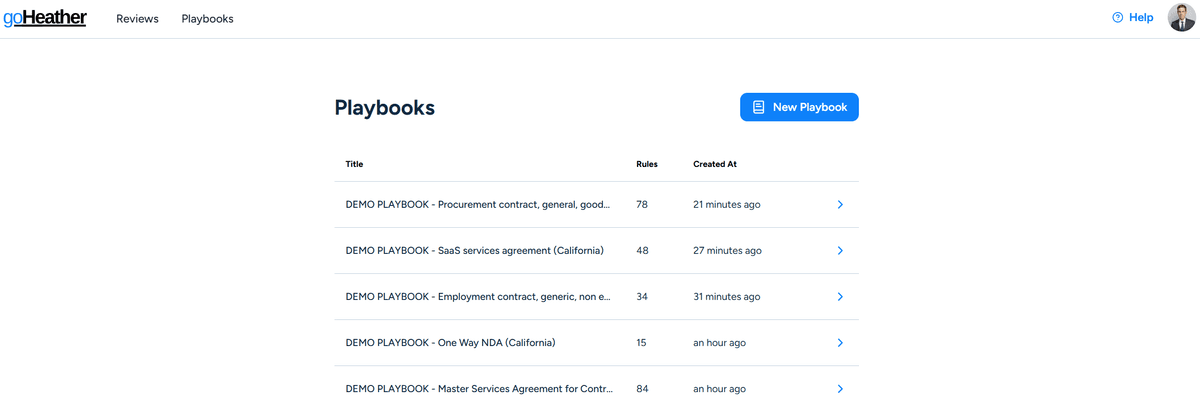
We just added five pre-built Demo Playbooks to goHeather and they're now available in every new account, ready to use or duplicate as your own starting point.
If you've been curious about what a contract review playbook looks like in practice, or you want a working example instead of starting from a blank page, these are for you.
A contract review playbook is a structured list of rules that tells goHeather's AI exactly what to look for when reviewing a contract.
Each rule is written in plain English — no code, no legal markup. Things like:
When you run a contract through goHeather using a Playbook, the AI checks every rule in your slef-made playbook and returns a result: Compliant, Non-Compliant, or Not Applicable — along with risk level, and a plain-English explanation of why, and a suggested edit where possible. goHeather also lets you surgically apply the edits with our Word Ad-In.
It's a red light / green light system for contract review. Green means the clause meets your standard. Red means it doesn't — and here's what to change.
Before we get to the Demo Playbooks, a quick recap of how playbooks work in goHeather:
Option 1: Build manually. Write your own rules from scratch in plain English. Full control, works great if you already have clear internal positions.
Option 2: Generate with AI. Upload a contract you already like — your "gold standard" agreement — and goHeather's AI extracts the key clauses and converts them into a ready-to-edit Playbook automatically.
Option 3: Start from a Demo Playbook. That's what we're announcing today. Pick one of our pre-built sample playbooks, duplicate it into your account, customize the rules to fit your business, and you're running reviews in minutes.
Each sample playbook was built for California and covers one of the most common contract types California businesses sign. They're clearly marked DEMO at the top of your Playbooks list. if your business is not in California, you can still the demo playbooks or even change them so they apply to your jurisdiction.
Here's what each one is designed to cover:
NDAs are the most frequently signed contract in any business — and one of the most frequently signed badly. This sample playbook is built around the provisions that matter most in a California confidentiality agreement: how confidential information is defined, what the receiving party is obligated to do with it, how long those obligations last, and what happens when disclosure is compelled.
It also accounts for California-specific enforceability requirements — NDAs that overreach beyond legitimate trade secret protection are vulnerable to challenge under California law, and this playbook is built with that in mind.
🔗 Try this playbook in goHeather →
An MSA sets the framework for an entire service relationship before individual projects begin. Getting the foundational terms right saves significant renegotiation time on every engagement that follows. This sample playbook covers the core commercial and legal provisions that belong in any California services agreement — from scope and payment to IP, liability, termination, and governing law.
🔗 Try this playbook in goHeather →
California employment law is among the most employee-protective in the country, and a contract drafted for another jurisdiction can create real exposure. This sample playbook is built around the provisions every California employer needs to get right — including at-will language, compensation, IP assignment, confidentiality, and the specific California restrictions on non-competes that make certain clauses automatically void.
🔗 Try this playbook in goHeather →
SaaS agreements carry a different set of risks than standard services contracts — and most generic playbooks miss them. This sample playbook is purpose-built for software and cloud services, covering the provisions that matter most to California buyers and vendors: data ownership, portability on termination, uptime commitments, CCPA/CPRA service provider language, security obligations, and liability terms.
🔗 Try this playbook in goHeather →
The broadest playbook in the set, built for the wide variety of vendor contracts California SMBs sign when buying goods, services, or software. Whether it's a supplier agreement, a statement of work, or a purchase order with attached terms, this playbook covers the procurement fundamentals — specifications, delivery, warranties, indemnification, liability, and termination.
🔗 Try this playbook in goHeather →
Step 1: Log in to goHeather and go to the Playbooks tab. You'll see the five Demo Playbooks at the top, clearly marked DEMO.
Step 2: Duplicate any Demo Playbook into your own account with one click. The rules are yours to edit — add, remove, or rewrite them to match your specific standards.
Step 3: Upload a contract — PDF or Word — and select your playbook.
Step 4: Review the results. Each rule returns Pass, Fail, or Not Applicable, with a plain-English explanation and a suggested edit where available.
That's it. From there, run every future contract of that type through the same playbook.
The hardest part of building a playbook is knowing where to start. Most teams have a sense of their positions on contracts, but translating those into specific, reviewable rules takes time.
A sample playbook solves that cold-start problem. It gives you a working set of rules out of the box, built against California law, so you're not starting from nothing. Run your first contract through it, see what comes back, and adjust from there.
If you'd rather build from one of your own contracts instead — upload your preferred agreement and use goHeather's AI Playbook Generation to extract the rules automatically.
Either way, the goal is the same: get your standards out of your head and into a system that applies them consistently, every time.
Enterprise customers get free assistance building custom Playbooks from the goHeather team.
If you're managing high contract volumes, have complex internal standards, or want a Playbook built to your specific clause positions rather than a general starting point — book a time with us and we'll help you build it.
Book an appointment with goHeather →
These five Demo Playbooks cover the most common California SMB contracts. More are in progress, including:
Jeff Dutton is a lawyer who advises on technology, corporate, privacy, commercial, employment and real estate law.
Jeff founded his own small law firm, Dutton Law, in 2016 (and merged it with a larger firm in 2019). Before that, Jeff was a prosecutor and a commercial law lawyer at a national boutique law firm.
Jeffrey is a frequent lecturer on legal matters and has been published in newspapers and trade journals. In addition, Jeff was the editor and co-author of a leading employment law text for lawyers for many years.
Education:
Western University, BA (2009)
University of Ottawa, Faculty of Law, JD (2012)
Get the latest contract tips, updates, and exclusive content straight to your inbox. Subscribe now and never miss out on what's new in contract law or at goHeather!
Our AI sifts through each clause, identifying potential risks. This enables us to provide quick yet comprehensive contract reviews, equipping you with the legal information you need to make informed decisions.
USA
1 Sansome St., Suite 1400
San Francisco, CA 94104
United States
International
10 Dundas St. East, Suite 1002
Toronto, ON M5B 2G9
Canada