FALL 2026 UPDATE
goHeather is now a full legal AI. Create documents, review documents, research the law.
Try For Free Now



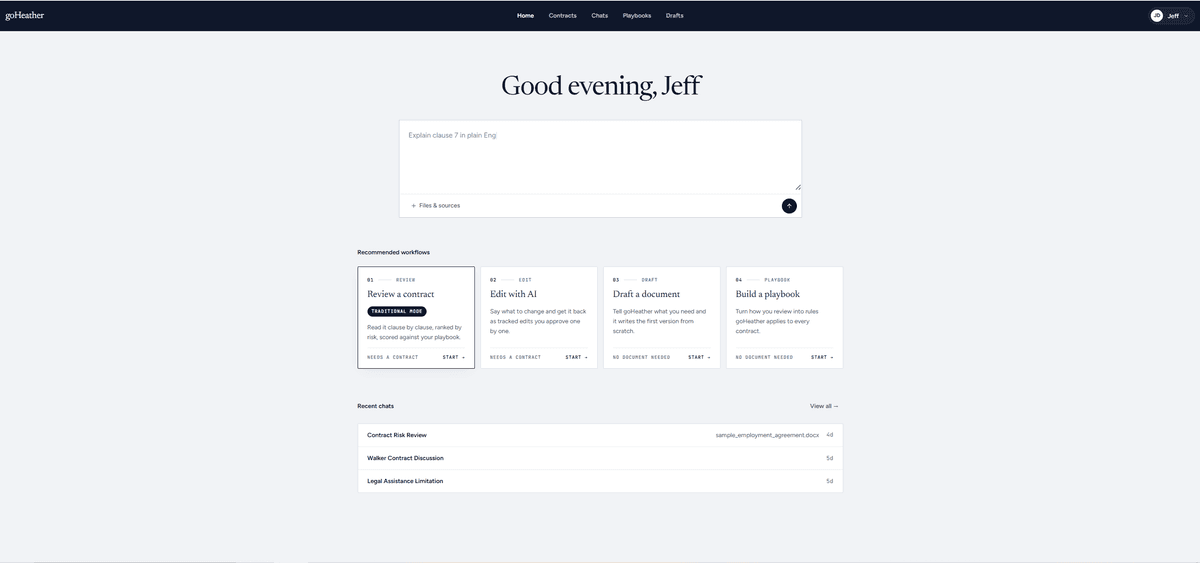
Ask ChatGPT or Claude to review a contract and it will review it. Upload the file, tell it you are the buyer, tell it what you care about, and you get back a clear read on the document. Where the liability cap sits, that the indemnity runs one way, that the term auto-renews for two years on thirty days notice, that the license to your data is broader than it needs to be. The reasoning is good. It comes back as text in the chat, and everything after that is yours to do. You read the analysis, decide which points matter for this vendor, ask for replacement language, copy each piece into the document, fix the formatting when it lands inside a table, note what you changed, save the version somewhere, and write the email back.
goHeather does the reading part with the same class of model and then keeps going. You load your playbook once, in plain English, and it gets applied to every contract without anyone retyping it. The contract opens in an editor beside a checklist of your positions, each one marked pass or fail with the clause it came from and a suggested edit. You click to apply an edit or dismiss it, and the change lands in the document in front of you. The review, the positions, and the versions stay in one place instead of in a transcript.
Price is not the difference. The top individual plans on ChatGPT and Claude run about $200 a month, which puts them in the same range as contract review software.
In a chat tool, the review is something you assemble each time. You bring the file, you bring the instructions, you carry the output back into the document by hand. Do it well and it works. Do it on a Thursday afternoon with four other things open and you get a shorter prompt, a different set of positions checked, and a couple of edits pasted in with the wrong indent.
In goHeather it is one button. The playbook is already there, so the same rules get checked in the same order on contract one and contract forty. The suggested changes are made as edits to the document rather than text you have to move, including in Word through the add-in, so what you finish with is the file you were going to send anyway.
That is the whole pitch. Same models, less handling.
The version we shipped in August is chat-native, so goHeather is not only a button anymore. You can open a conversation with no document in it and ask what a notice provision requires you to do by when, think through how hard to push on an indemnity, or draft a consulting agreement from scratch and get a Word file back that you edit in the browser. Review findings you decide you cannot live with get flagged and collected into a negotiation list you can send to the other side.
So the choice is not thinking versus mechanics. Both tools reason about your contract. Only one of them ends with the tracked changes in the document.
Setting up a playbook is real work. It is an hour or two of deciding what your positions actually are and writing them in plain English, and if nobody wants to do that, goHeather has less to work with and you get a more generic review.
The AI also gets calls wrong. It will fail a clause that is fine and it will miss things. The checklist, the accept or dismiss buttons, and the flags on weak drafting sections exist because a person is still making the decision on every item. We run on the same frontier models everyone else does, so we are not claiming to out-think them.
At three or four contracts a month, the handling is an afternoon and you can live with it. At forty, the handling is the job. That is where a contract review workflow built around a playbook starts to pay, because the part being automated is not the thinking, it is the twenty steps between the answer and a document you can send back.
goHeather is free to try. Run one of this week's contracts through it and see what comes out the other end.
Jeff Dutton is a lawyer who advises on technology, corporate, privacy, commercial, employment and real estate law.
Jeff founded his own small law firm, Dutton Law, in 2016 (and merged it with a larger firm in 2019). Before that, Jeff was a prosecutor and a commercial law lawyer at a national boutique law firm.
Jeffrey is a frequent lecturer on legal matters and has been published in newspapers and trade journals. In addition, Jeff was the editor and co-author of a leading employment law text for lawyers for many years.
Education:
Western University, BA (2009)
University of Ottawa, Faculty of Law, JD (2012)
Get the latest contract tips, updates, and exclusive content straight to your inbox. Subscribe now and never miss out on what's new in contract law or at goHeather!
Our AI sifts through each clause, identifying potential risks. This enables us to provide quick yet comprehensive contract reviews, equipping you with the legal information you need to make informed decisions.
USA
1 Sansome St., Suite 1400
San Francisco, CA 94104
United States
International
10 Dundas St. East, Suite 1002
Toronto, ON M5B 2G9
Canada