FALL 2026 UPDATE
goHeather is now a full legal AI. Create documents, review documents, research the law.
Try For Free Now



This week I ran a test on Claude. I uploaded a contract and asked it to redline the document from a buyer’s perspective. "Light touch. Deal-breakers only."
The contract was Zoom’s standard MSA, pasted into Word and saved as a DOCX file.
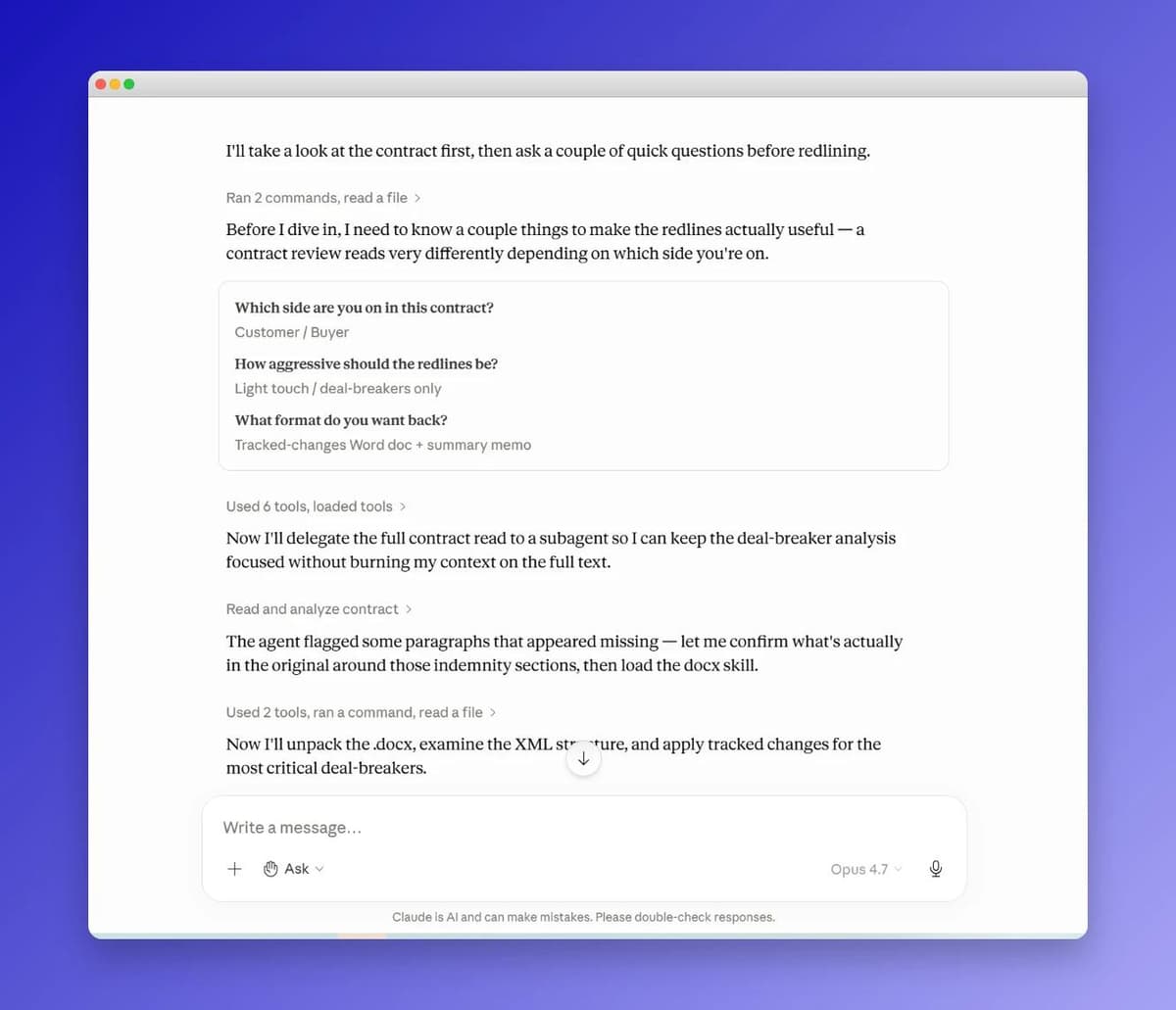
Thirteen minutes later, I stopped the review while it was still thinking.
Claude's analysis in that 13 minutes appeared solid as it was streaming. It seemed to catch issues like a unilateral termination right, a broad license to Customer Content, a liability-cap carve-out for data breaches, and a missing breach notice. The legal reasoning seemed solid. If I had read the output as a memo, I would have said the reviewer knew what they were doing.
The problem was not the thinking. It was the workflow.
Claude tried to write tracked changes directly into a Word XML file in the background because Claude does not have Word editor built into it. One edit silently cut roughly a hundred lines off the end of the document. By the time Claude noticed and started trying to recover, the test was over. It had taken 13 minutes and I gave up because I still hadn't been presented any proposed redlines.
Look, I'm a power user of Claude. I have built entire websites and mini-apps that I shipped to users in 10 minutes or less with Claude. But Claude could not redline a Word document for me in Cowork with similar speed or capability. Claude is great a code, its not so great at redlining a contract.
The same review of Zoom's MSA took goHeather under two minutes.
That blog post is not an argument against Claude. We use Claude at goHeather in two ways. First, we use Opus under the hood to chunk a document, along with models from OpenAI and Google to review and add new language to a document. Second, we built many parts of goHeather with Claude. In short: This blog post is not cope, and I think Anthropic is one of the most important companies in the world and that everybody should have a Claude account, whcih you can try here.
every contract reviewer should also have a goHeather account. The Claude contract review test showed something specifically wrong with its workflow to review contracts that goHeather fixes. Claude does not have a native editor that can apply redlines one by one from a checklist of pass/fails against a playbook. That is not a knock on the model. The chat interface is just not built to do it.
Contract review is a workflow. You have a document, a playbook (a set of standard positions), and a reviewer who has to decide what to accept. The reasoning part - does this indemnity protect us, is the cap below market, is the license too broad - is one job. The execution part - open the document, find the clause, apply the change, mark it for review, move on to the next issue - is a completely different job. You also need consistency. If your playbook says liability should be capped at two times fees, the tool has to apply both that Playbook and that position every time, not just when the prompt happens to be phrased well or the Skill is captured. We have all experienced adding Skills to Claude and it forgetting to use that Skill.
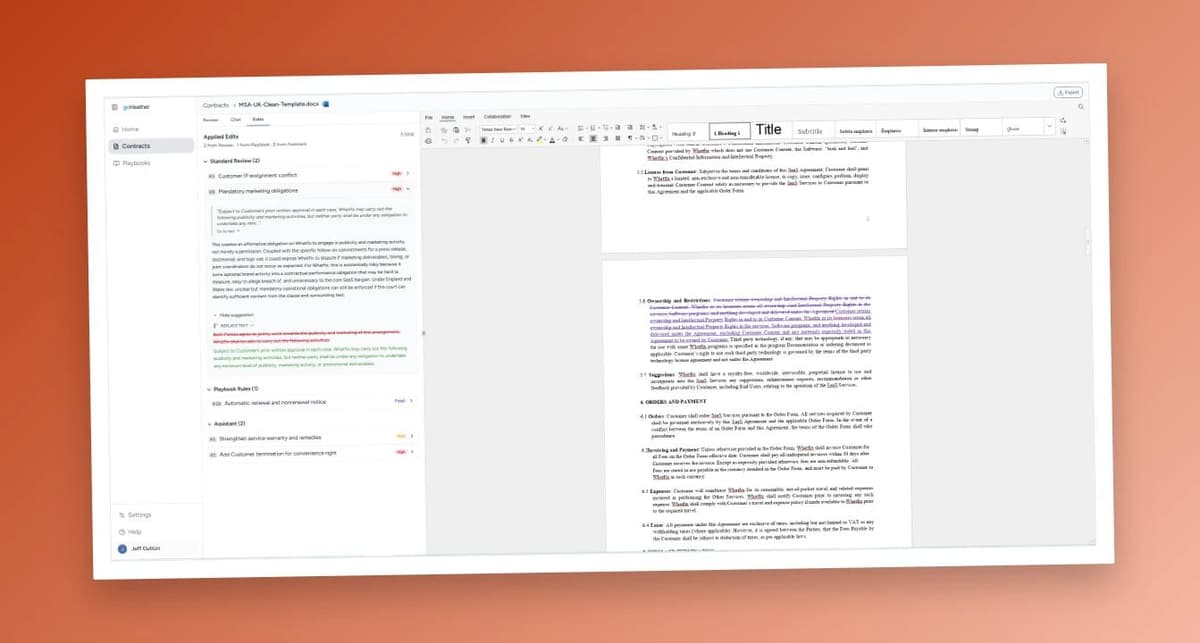
A chat tool is built for a summary of the generic legal issues in a contract. It will read a contract and tell you what is wrong with it. What it cannot do is walk you through those issues one at a time, in front of the document, with a button for Accept and a button for Dismiss such changes and actually apply the changes, surgically, in front of you, one by one. Claude simply cannot do this. That gap is the entire reason goHeather exists.
goHeather is not trying to be a smarter Claude. It is trying to turn the model's reasoning into finished contract work. In goHeather, that means the contract opens in an Office-style editor in the browser. The review appears beside the document as a checklist of issues, organized by playbook position. Each item shows the clause that was flagged, a pass or fail call against your standard, a short explanation, and a redline preview. You hit Accept or Dismiss. When you accept a suggestion, the edit lands in the right place in the document, including inside tables and multi-paragraph clauses where copying from a chat would have meant ten minutes of formatting cleanup.
This sounds like plumbing until you have done a few real reviews. In a chat tool, the answer is usually trapped in the chat. You read the suggestion, find the clause, copy the language, paste it into Word, fix the formatting, and then check whether the change still makes sense in context. The model may have done the hard intellectual part, but the user is still doing the workflow. goHeather takes that last mile seriously.
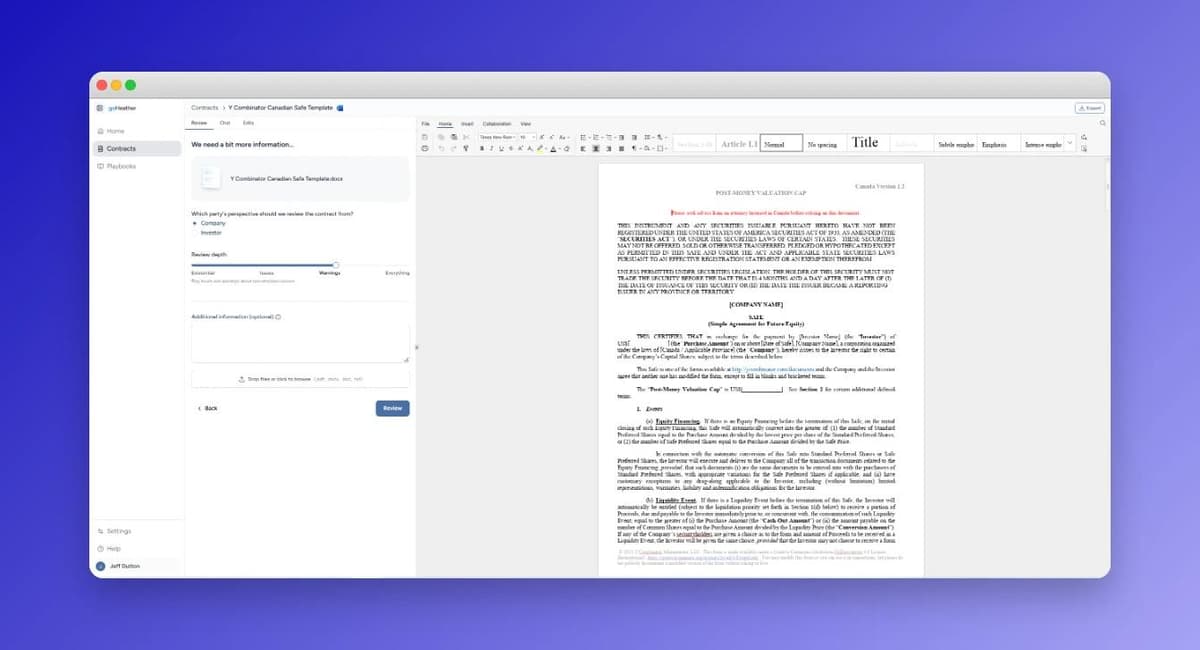
The playbook is built into the review in goHeather, so the user does not have to remember to prompt the model correctly. The review depth is configurable, so an NDA can get a fast risk pass while a major services agreement can get a deeper review. The AI chat is also connected to the document, so if you ask for a clause to be changed, it can propose an edit and apply it directly instead of giving you text to copy.
That is the difference between a AI general assistant and a purpose-built AI contract review product.
Claude is excellent for understanding a clause, brainstorming language, or thinking through a negotiation point. But if the job is to review a Word document contract against a playbook and produce usable redlines surgically one by one, with an audit trail, the interface matters as much as the intelligence. The reviewer's hands need to be on the document, not on a chat transcript.
The bet behind goHeather is not that frontier models will stop improving. They will keep getting better, and that helps us. The bet is that contract review has a specific shape, a document, a playbook, a checklist of pass/fails, a redline you accept one at a time, and that shape is worth building around.
A chat transcript is not a redline. A prompt is not a playbook. A memo is not a reviewed contract.
Claude can review your contract. goHeather turns that review into the thing you actually need: a marked-up document you can send back.
Try goHeather for free and see for yourself here.
Jeff Dutton is a lawyer who advises on technology, corporate, privacy, commercial, employment and real estate law.
Jeff founded his own small law firm, Dutton Law, in 2016 (and merged it with a larger firm in 2019). Before that, Jeff was a prosecutor and a commercial law lawyer at a national boutique law firm.
Jeffrey is a frequent lecturer on legal matters and has been published in newspapers and trade journals. In addition, Jeff was the editor and co-author of a leading employment law text for lawyers for many years.
Education:
Western University, BA (2009)
University of Ottawa, Faculty of Law, JD (2012)
Get the latest contract tips, updates, and exclusive content straight to your inbox. Subscribe now and never miss out on what's new in contract law or at goHeather!
Our AI sifts through each clause, identifying potential risks. This enables us to provide quick yet comprehensive contract reviews, equipping you with the legal information you need to make informed decisions.
USA
1 Sansome St., Suite 1400
San Francisco, CA 94104
United States
International
10 Dundas St. East, Suite 1002
Toronto, ON M5B 2G9
Canada